Spiro Gear Spiro Gear

How to Choose the Right Linear Actuator?

Time:2026-09-16 Author:Henry
0%

Choosing the right Linear Actuator begins with understanding the movement, not browsing product photos. A compact actuator may lift a hinged lid smoothly, yet struggle under repeated side loading. Define the required stroke, load, speed, mounting space, and duty cycle before comparing models. Measure the real load, including friction and leverage. Small calculation errors can become expensive failures.

Experienced technicians also inspect the working environment. Dust, moisture, heat, vibration, and cleaning chemicals can quickly affect actuator performance. Check the actuator’s protection rating and material suitability. Confirm whether the system needs limit switches, position feedback, manual override, or synchronized movement. A 300-millimeter stroke may look ideal on paper. It may still collide with a frame at full extension.

Reliability depends on more than rated force. Review duty-cycle limits, noise levels, power requirements, mounting orientation, and expected service life. Compare manufacturer data with independent testing, installation guidance, and replacement-part availability. Ask how the actuator behaves during power loss. That detail matters in adjustable workstations, medical equipment, automation systems, and outdoor mechanisms.

There is no perfect selection formula. A neat spreadsheet can hide a poor assumption. Recheck measurements under real operating conditions, preferably with a temporary test setup. Choose a safety margin without oversizing unnecessarily. An oversized actuator can increase cost, energy use, and structural stress. The best choice balances performance, control, durability, safety, and long-term maintenance.
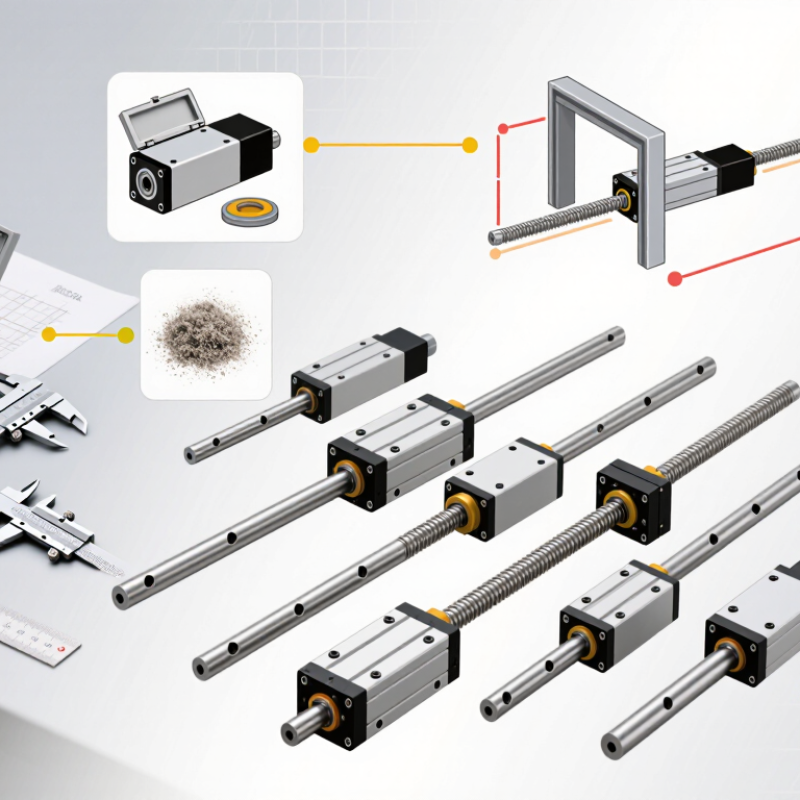
How to Choose the Right Linear Actuator?

Define the Application Requirements for the Linear Actuator

Choosing a linear actuator starts with the application, not the catalog. Define the load, stroke, speed, accuracy, and mounting position. Include friction, acceleration, vibration, and unexpected shock. A 200-kilogram load moving horizontally differs greatly from the same load lifting vertically. Calculate the required force, then add a realistic safety margin. Oversizing is not always safer. It can increase cost, noise, and energy use.

Duty cycle needs equal attention. Record movements per hour, rest periods, and daily operating time. The International Federation of Robotics reported 541,302 industrial robot installations worldwide in 2023. This growth highlights the need for repeatable motion and reliable thermal management. An actuator that works well for ten cycles may overheat after ten thousand. Check ambient temperature, dust, moisture, washdown exposure, and available space. Measure the actual mounting envelope with a ruler. Drawings can mislead.

Control requirements should be defined early. Specify limit sensing, feedback resolution, emergency stopping, and communication needs. The U.S. Department of Energy’s Motor Systems Market Assessment identifies motor-driven systems as major industrial electricity users. Efficient motion therefore depends on correct sizing, not marketing claims. Test a prototype under the heaviest realistic load. I would not skip this step. Early calculations can still be wrong. Recheck them against measured current, travel time, and surface temperature before approving the final design.

Compare Actuator Types, Motion, and Control Methods

How to Choose the Right Linear Actuator?

Choosing a linear actuator starts with comparing actuator types, motion requirements, and control methods. Electric actuators suit clean environments and provide accurate positioning. Hydraulic systems deliver high force for heavy loads, but they need pumps, hoses, and regular leak inspections. Pneumatic cylinders move quickly and cost less, although compressed air can make positioning less precise. Force is only one part of the decision. Consider stroke length, cycle frequency, speed, noise, and available installation space.

Motion profiles often reveal hidden problems.

A 300 mm stroke may appear suitable, but the load could require acceleration control near both endpoints. Shorter strokes may improve stability. For repeatable positioning, choose feedback through an encoder or potentiometer. Basic on/off control works for simple opening and closing tasks. Limit switches can confirm end positions. More advanced systems use a programmable controller to adjust speed and position during movement. Pneumatic and hydraulic systems may need proportional valves for smoother control.

Environmental details matter.

In dusty or wet areas, check the enclosure rating and connector protection. Also inspect the mounting points, side loads, and cable routing. I have learned that a theoretical load calculation can be misleading. This assumption can fail. Real friction, misalignment, and temperature change performance. Test the actuator under its actual load when possible. Leave room for maintenance access. Review the control signal, emergency stopping behavior, and duty cycle before installation.

Calculate Load, Speed, Stroke, and Duty Cycle

Selecting a linear actuator begins with numbers, not catalog photos. Convert the moving mass into force: F = m × 9.81, then add friction and acceleration loads. A 400 kg platform already requires about 3,924 N before resistance. Add a safety margin, often 25–50%, when impact or misalignment is possible. The U.S. Department of Energy reports that motor-driven systems consume roughly 60–70% of industrial electricity. Efficient sizing matters.

Speed comes from travel time: v = stroke ÷ time. A 600 mm stroke completed in 12 seconds needs 50 mm/s. Do not confuse peak speed with rated speed under load. Choose the stroke from the real movement, then reserve clearance at both ends. Longer strokes can increase bending, vibration, and screw wear. Duty cycle is equally important: on-time divided by total cycle time. For five seconds running and fifteen seconds resting, the duty cycle is 25%. Thermal performance may still worsen in hot, enclosed equipment. IEC 60034-1 provides a useful reference for motor duty classifications, but the complete actuator assembly needs testing.

Tips: Record actual force, speed, temperature, and cycle time during a pilot test. Measure twice. A static bench test can hide acceleration peaks. Review the calculation after installation, because guides, seals, and uneven mounting often add friction. I have seen a theoretically correct selection fail because its “maximum load” excluded side loading. That detail is easy to miss.

How to Choose the Right Linear Actuator?

Calculate the required load, speed, stroke, and duty cycle before selecting an actuator.

Load Calculation

For a 50 kg payload on a 20% rolling-resistance surface, the chart includes a 25% safety factor.

Speed

Required speed = stroke ÷ travel time. A 300 mm stroke completed in 10 seconds requires at least 30 mm/s.

Stroke

Choose a stroke equal to the actual mechanical travel, while allowing space for mounting and end stops.

Duty Cycle

Duty cycle = operating time ÷ total cycle time. Ten seconds of operation in a 60-second cycle equals 16.7%.

Estimated force uses F = m × g × (sin θ + μ cos θ) × 1.25, where m = 50 kg, g = 9.81 m/s², μ = 0.20, and the safety factor is 25%. Confirm the result with the actuator manufacturer’s load, speed, thermal, and mounting specifications.

Evaluate Mounting, Environment, Safety, and Service Life

How to Choose the Right Linear Actuator?

Mounting is the first practical decision. Measure the available space, pivot points, stroke length, and retracted length. The actuator must push along its intended axis. Side loads can bend shafts, increase friction, and shorten service life. Use clevis mounts or pivot brackets where movement changes during operation. Leave room for wiring and maintenance access. A tight installation often looks efficient, but it can become difficult to repair.

Environment changes the specification. Dust, water spray, chemicals, vibration, and temperature can affect performance. Select suitable protection ratings and confirm the operating temperature range. Consider stainless hardware in damp locations. For outdoor equipment, protect connectors from water entry. Safety deserves equal attention. Check the maximum load, duty cycle, speed, and stopping behavior. Built-in limit switches help prevent overtravel, while overload protection reduces mechanical damage. An emergency stop may still be necessary. Never rely on one safeguard.

Tips: Test the actuator under real load, not only on a workbench. Watch for unusual noise, heat, uneven movement, or delayed stopping. Record cycle counts and inspection dates. This simple record supports better service-life estimates. Still, calculations can mislead. Actual friction, alignment, and impact loads are often higher than expected. Review the design after early trials, and reduce the load or duty cycle if performance changes. A small safety margin matters. So does regular inspection.

Select the Best Actuator and Verify Its Specifications

How to Choose the Right Linear Actuator?

Select the Best Actuator and Verify Its Specifications

Choosing a linear actuator starts with the load, stroke, speed, and duty cycle. Do not select by force alone. A 500-newton actuator may lift the load, yet fail during repeated starts or uneven alignment. Measure the real load, including friction, brackets, and acceleration. Then add a practical safety margin, usually 20% to 30%.

The specification sheet needs closer inspection. Verify rated force, peak force, stroke tolerance, retracted length, backlash, noise, ingress protection, and feedback type. Check whether the stated speed applies under load. It often does not. The International Federation of Robotics reported 541,302 industrial robot installations in 2023. This growth increases demand for repeatable motion and dependable position feedback. The U.S. Department of Energy also reports that motor-driven systems consume roughly 70% of industrial electricity. Efficient actuator sizing can therefore reduce wasted energy, not just improve movement.

Tips: Test the actuator under the worst expected load. Record current, temperature, travel time, and stopping accuracy. Compare results with the datasheet. A short bench test can expose a serious mismatch. Confirm mounting orientation and side-load limits. I have seen designs fail because a guide rail carried too much bending force. That mistake is easy to repeat. Leave room for uncertainty, because laboratory figures rarely match dusty, vibrating equipment. Cite: International Federation of Robotics, World Robotics 2024; U.S. Department of Energy, Motor Systems Market Assessment.

FAQS

What details should I define before choosing a linear actuator?

Define load, stroke, speed, accuracy, mounting position, and movement direction. Include friction, acceleration, vibration, and possible shock. A horizontal 200-kilogram load differs from a vertical lift. Calculate required force, then add a sensible safety margin.

Is a larger actuator always safer?

No. Oversizing can increase cost, noise, and energy use. It may also create unnecessary mechanical stress. The largest option is not automatically the best option.

How should I evaluate the duty cycle?

Record cycles per hour, rest periods, and daily operating time. Ten easy cycles do not prove long-term reliability. Thousands of cycles may create heat. Check motor temperature during realistic testing.

Which actuator type suits different applications?

Electric actuators support clean operation and accurate positioning. Hydraulic systems provide high force but require pumps, hoses, and leak checks. Pneumatic cylinders move quickly, though positioning can be less precise. Compare noise, space, speed, stroke, and cycle frequency.

What control features might I need?

Simple opening and closing may only need on-off control. Limit switches can confirm end positions. Encoders or potentiometers provide position feedback. More advanced systems can adjust speed during travel. Check emergency stopping and communication requirements early.

How can mounting problems reduce actuator life?

The actuator should push along its intended axis. Side loads can bend shafts and increase friction. Use pivot brackets when the movement angle changes. Leave space for cables, tools, and maintenance.

What environmental conditions should I check?

Review dust, water spray, chemicals, vibration, and temperature. Confirm enclosure protection and connector sealing. Damp locations may need corrosion-resistant hardware. Outdoor connectors need protection from water entry. Small details matter.

How should I test an actuator before final approval?

Test it under the heaviest realistic load, not only on a workbench. Measure current, travel time, heat, noise, and stopping behavior. Watch for uneven movement. Early calculations can be wrong. Recheck the design after testing.

What safety and maintenance practices are important?

Check load limits, duty cycle, speed, and overtravel protection. Limit switches help, but never rely on one safeguard. Overload protection can reduce mechanical damage. Record cycle counts and inspection dates. Inspect regularly.

Conclusion

Choosing the right Linear Actuator begins with a clear understanding of the application. Define the required movement, load direction, operating frequency, available space, and desired level of precision. Then compare suitable actuator types according to their motion, drive mechanism, control options, response speed, and positioning accuracy. A careful calculation of load capacity, travel speed, stroke length, and duty cycle is essential to ensure reliable performance without excessive wear or overheating.

The selection process should also consider mounting points, installation alignment, environmental conditions, noise, safety features, maintenance requirements, and expected service life. Factors such as dust, moisture, temperature, and vibration may influence the actuator’s materials and protection rating. After identifying the best option, verify all technical specifications, including force, speed, stroke, power requirements, feedback, and control compatibility. Testing the actuator under realistic operating conditions can further confirm that it meets performance, safety, and durability expectations.

Henry

Henry

Henry is a dedicated marketing professional with a profound expertise in the company's offerings. With years of experience in the industry, he possesses an impressive understanding of the market dynamics and consumer behaviors that drive success. Henry is committed to sharing his insights through......