Spiro Gear Spiro Gear

Who Are the Top Servo Drive Manufacturers in China?

Time:2026-11-02 Author:Henry
0%

China has become an important source of servo technology for automation builders seeking precise motion control and competitive production costs. Servo Drive systems now appear in packaging lines, CNC equipment, robotics, and electronics assembly, where speed and positioning must remain stable. Yet “top” depends on the machine, not just the brand. A compact drive for a labeling unit may not suit a high-inertia axis or a multi-axis system. That matters.

This guide compares leading Chinese manufacturers through practical criteria: product range, motor compatibility, communication options, overload capability, commissioning tools, documentation, and after-sales support. Buyers should also check firmware details, spare-part access, and the quality of local technical assistance. A polished catalog is not enough. Performance claims need verification against current datasheets, application tests, and references from comparable installations. Before purchasing, teams can confirm encoder and fieldbus support, then test tuning, alarms, and thermal behavior under realistic loads. Small details matter.

The overview aims to explain where different suppliers may fit and which questions deserve closer review. Market positions change, and public information can be uneven. A clear shortlist is only a starting point, not a substitute for engineering validation. A brief trial on the intended machine can reveal issues that a specification sheet misses.
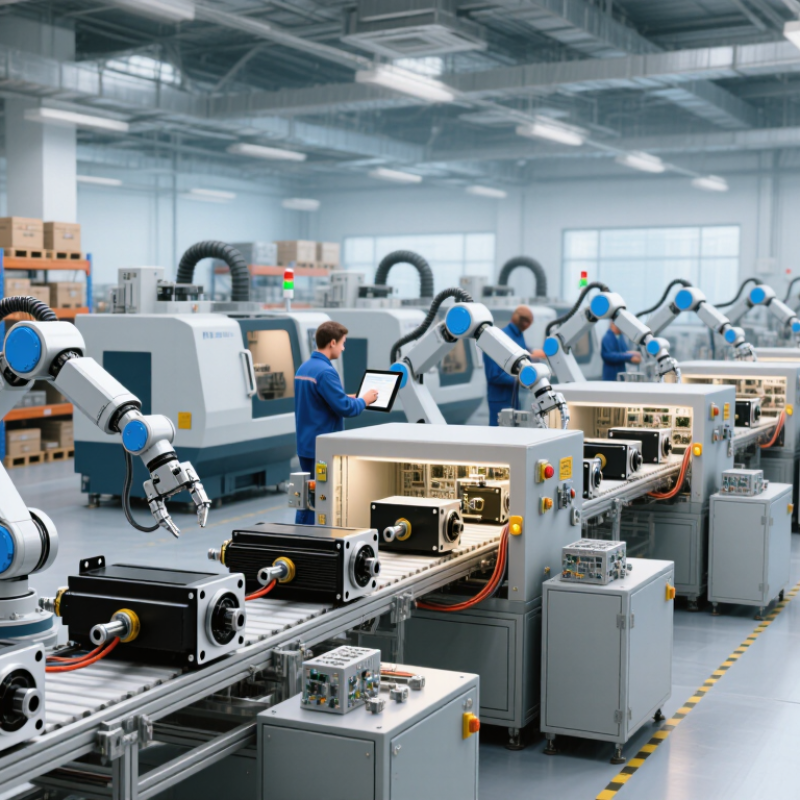
Who Are the Top Servo Drive Manufacturers in China?

What Is a Servo Drive and How Does It Work?

A servo drive is the electronic unit that controls a servo motor’s movement. It converts incoming electrical power into carefully regulated current and voltage. A motion controller sends a target, such as a position, speed, or torque. The drive then adjusts motor power to follow that command. Think of a packaging line where a motor must stop a film roll at a precise mark. Small timing errors can shift the print. Precision matters.

Most systems use feedback from an encoder or resolver attached to the motor. The drive compares this feedback with the requested movement and corrects the difference many times per second. It may manage current, speed, and position through nested control loops. In some machines, the main controller handles the position loop instead. The exact arrangement depends on the equipment. Feedback helps, but it cannot fix every problem.

A practical setup also depends on motor sizing, load inertia, wiring, and parameter tuning. For example, a heavy vertical axis may need different settings from a light indexing table. Poor tuning can cause vibration, overshoot, or excess heat. That distinction matters. Engineers often adjust gains gradually while observing motion and motor temperature. The process is not always neat; real loads can behave differently from calculations, so testing under working conditions remains important.

How Servo Drives Control Motion

Servo drives use nested control loops to regulate motor current, speed, and position. The ranges below are representative examples, not specifications for every drive; actual bandwidth depends on the drive, motor, load, and tuning.

How Are Chinese Servo Drive Manufacturers Evaluated?

Evaluating Chinese servo drive manufacturers starts with the machine’s real operating conditions, not a brochure headline. Check the rated power, continuous and peak current, overload duration, and supported motor feedback types. Ask for torque-speed curves and test records under loads similar to yours. A drive that performs well on a light bench may behave differently on a fast packaging axis.

Look closely at control quality. Request measured positioning repeatability, settling time, and speed stability, then confirm how these results were tested. Details matter. Check compatibility with your controller, communication protocol, and existing safety architecture. Review thermal limits and electromagnetic compatibility data, especially if the cabinet is crowded or runs hot. Reliable manufacturers can explain production checks, traceable component inspection, firmware revisions, and how they handle field failures. Ask what support is available during commissioning, and whether technical staff can review alarms and parameter settings. A clear manual helps, but a short response time can matter more when a line is stopped. One weakness in this evaluation is that factory demonstrations rarely reproduce every real-world vibration or wiring issue. Leave room for a pilot installation, and record the problems that remain unresolved.

Who Are the Top Servo Drive Manufacturers in China? — How Are Chinese Servo Drive Manufacturers Evaluated? A manufacturer-neutral framework for comparing servo drive suppliers using documented evidence and application requirements.
Evaluation Dimension Suggested Weight Evidence to Review What a Strong Result Looks Like
Performance and motion control 20% Published speed, torque, response, positioning, and tuning specifications; test results for the intended motor-and-drive combination. Specifications are clearly stated, supported by test documentation, and suitable for the required machine cycle and load.
Reliability and protection 18% Operating-temperature and overload ratings, protection functions, fault records, warranty terms, and documented reliability tests. Protection behavior and operating limits are documented, and reliability claims can be checked against records or test reports.
Product range and application fit 12% Available power and voltage options, compatible motor types, product documentation, and application references relevant to the buyer's use case. The supplier offers a clearly specified configuration that meets the application requirements without relying on unsupported claims.
Interfaces and system compatibility 12% Supported communication protocols, encoder options, software tools, wiring information, and compatibility documentation. Interface support is listed in product documentation, and integration can be verified with the intended controller and feedback devices.
Safety and regulatory documentation 10% Applicable declarations, certificates, and test documentation. Relevant references may include IEC 61800-5-1 for adjustable-speed electrical power drive systems and IEC 61800-3 for EMC requirements. Documentation identifies the applicable product and scope; certificates and test reports can be checked with the issuing body where appropriate.
Manufacturing and quality management 10% Quality-management documentation, production traceability, inspection procedures, and corrective-action processes. Quality processes are documented and consistently applied; any claimed management-system certification is current and verifiable.
Technical support and service 10% Support availability, response procedures, troubleshooting resources, training, spare-parts arrangements, and warranty support. Support responsibilities and service terms are clearly defined and appropriate for the buyer's location and operating schedule.
Customization and delivery capability 8% Engineering-change procedures, customization scope, sample or pilot processes, production lead-time estimates, and delivery records. Custom requirements, approvals, lead times, and change controls are documented before an order is placed.
Suggested use: Score each dimension on a consistent 1–5 scale, multiply each score by its weight, and compare suppliers only after confirming that their documentation covers the same product configuration and application requirements. The weights are a suggested evaluation model, not an independently verified ranking of manufacturers.

Which Companies Lead China’s Servo Drive Industry?

China’s servo drive leaders are best understood by capability, not by a single public ranking. The strongest groups typically combine drive design, motor matching, motion-control software, and local technical support. They serve packaging lines, machine tools, electronics assembly, and robotics. Buyers often assess response time, tuning effort, heat management, and performance under changing loads. Small details matter.

Demand is substantial. The International Federation of Robotics’ World Robotics 2024 report recorded 276,288 industrial robot installations in China in 2023, about 51% of global installations. The National Bureau of Statistics reported 2023 industrial robot output of 429,500 units. These figures indicate a large automation ecosystem, but neither report directly ranks servo drive suppliers. That distinction matters.

In practice, domestic leaders include diversified automation manufacturers and specialist motion-control firms with broad product ranges and established service networks. Their advantages often include application engineering, shorter local support routes, and products tailored to common production equipment. Yet market leadership can look different across sectors. Public rankings also vary by shipment value, unit volume, and product scope. I would treat any single league table cautiously.

How Do Their Products and Technologies Compare?

Chinese servo drive manufacturers differ less by headline power ratings than by control quality, integration, and support. Some focus on compact drives for packaging machines; others offer higher-capacity systems for machine tools or robotics. A 400-watt unit may suit a small indexing table, while a larger application needs careful motor, encoder, and load matching. Ratings alone tell little.

Control functions deserve close inspection. Look for torque and speed response, encoder compatibility, auto-tuning, and communication options such as EtherCAT or pulse control. In a real commissioning test, a drive should hold a steady speed as the load changes, without excessive vibration or heat. Fast tuning helps, but it cannot fix poor mechanical alignment. That detail is easy to overlook.

Product ecosystems also vary. One manufacturer may provide matched motors, cables, and configuration software, reducing setup friction. Another may offer broader motor compatibility, but require more manual parameter checks. Documentation quality matters: clear wiring diagrams and fault descriptions save time on a factory floor. Support can be uneven, even within the same product range. I would compare sample manuals, software workflows, and local service response before choosing. A small trial on the actual machine often reveals more than a polished specification sheet.

Where Are Chinese Servo Drives Commonly Used?

Chinese servo drives are widely used in factory automation, where motors must move accurately and repeat the same motion throughout a shift. On a packaging line, a drive can control a conveyor, align a carton, or coordinate a sealing jaw. In electronics production, it may position a small component beneath a camera. That precision matters.

Machine-tool builders also use servo systems for axis movement, tool changes, and rotary tables. Robotics, textile equipment, and automated assembly lines rely on them for controlled speed and positioning. A practical detail often missed is the load: a compact motor may handle a light pick-and-place arm, but not the same motion with a heavier fixture. Not everywhere, though. Dust, vibration, heat, and frequent starts can change what works well.

For buyers, the application is more useful than a headline torque rating. Check the motor’s feedback type, required travel, peak load, and communication interface against the machine’s controller. Leave room for acceleration and braking; real production rarely follows an ideal cycle diagram. A drive can appear suitable on paper and still need tuning on the line. Small details count. Servo technology is not automatically the best fit for every machine, especially when motion is simple and cost matters more than fine positioning.

FAQS

Can one company be named China’s clear servo drive leader?

Not reliably. Leadership depends on the sector, product range, shipment measure, and service coverage. Public rankings can differ.

What makes a strong servo drive supplier?

Look for drive and motor matching, motion-control software, application engineering, and responsive local support. Small details matter.

What do industry figures say about demand in China?

China recorded 276,288 industrial robot installations in 2023, about 51% of the global total. This shows a large automation market, not a supplier ranking.

How should buyers compare servo drive performance?

Check speed and torque response, encoder compatibility, tuning tools, and communication options. Ratings alone tell little.

How can a drive be tested under changing loads?

Run it on the intended machine. Watch for unstable speed, vibration, and excess heat as the load changes. A datasheet cannot show everything.

Why does motor matching matter?

The motor, encoder, and load must suit the application. A 400-watt drive may fit a small indexing table, but not every setup.

Do matched motors, cables, and software make installation easier?

Often, yes. A complete set can reduce setup work, while broader compatibility may require extra parameter checks. Not always.

What should buyers check before making a decision?

Review wiring diagrams, fault descriptions, software workflows, and local service response. Try a small application test. I would still verify the details.

Conclusion

This article explains what a Servo Drive does and how it works with a motor and control system to regulate motion, speed, and position. It also outlines the main factors used to evaluate manufacturers in China, such as product performance, reliability, technical capabilities, support, and suitability for different automation needs.

The article then surveys the companies shaping China’s servo drive industry without focusing on brand names, comparing their product ranges and approaches to technology. It concludes by looking at common applications, including industrial machinery, robotics, packaging equipment, and other automated systems. Together, these topics offer readers a practical overview of how to assess a Servo Drive and choose solutions that fit their operational requirements.

Henry

Henry

Henry is a dedicated marketing professional with a profound expertise in the company's offerings. With years of experience in the industry, he possesses an impressive understanding of the market dynamics and consumer behaviors that drive success. Henry is committed to sharing his insights through......